

Why do you halve the coefficient of x and square it when completing the square?
The short answer
In (x + k)², the two cross terms are each kx, giving 2kx in total. To match x² + bx, choose k = b/2. The square then contains the constant k², so the number that completes it is (b/2)².
To rewrite an expression without changing its value, add that constant and subtract it. To complete a square in an equation, you can instead add the same constant to both sides.
Find the two copies of kx
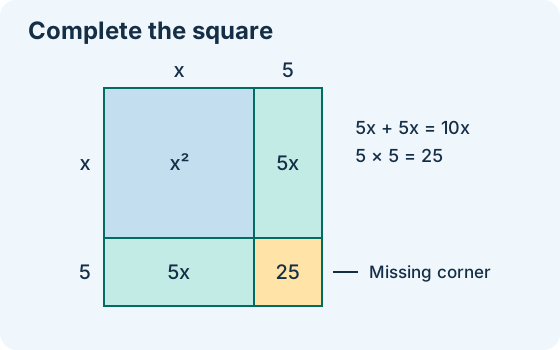
Multiply (x + k)(x + k) term by term. The products are x², kx, kx, and k². If the original expression contains 10x, the two copies must each be 5x. That makes the missing corner 5 × 5 = 25.
For positive x, the same calculation describes a square of side x + 5. Its four regions have areas x², 5x, 5x, and 25. Expansion proves the identity for every real x.
Keep the original expression equal
Rewrite x² + 10x + 19 as x² + 10x + 25 − 25 + 19. The first three terms form (x + 5)², leaving (x + 5)² − 6.
The square reaches zero at x = −5, so the graph of y = x² + 10x + 19 has its minimum at (−5, −6). The numbers inside and outside the square have different jobs. Check the horizontal coordinate by setting x + 5 equal to zero.
Solve an equation with a negative middle term
Solve x² − 8x + 7 = 0. Move 7 to the other side to get x² − 8x = −7. Half of −8 is −4, and (−4)² is 16. Add 16 to both sides to get (x − 4)² = 9.
The quantity x − 4 can be 3 or −3. That gives x = 7 or x = 1. Both satisfy the original equation, which also factors as (x − 1)(x − 7) = 0.
Factor out the leading coefficient first
For 3x² − 12x + 5, first group the variable terms as 3(x² − 4x) + 5. Inside the brackets, half of −4 is −2, and its square is 4.
Write 3[(x − 2)² − 4] + 5. Distribute the outside 3 to get 3(x − 2)² − 7. The adjustment inside the brackets becomes −12 outside them.
Check by expanding back
Expand 3(x − 2)² − 7 to get 3(x² − 4x + 4) − 7, or 3x² − 12x + 5. Compare all three coefficients with the starting expression.
When b is odd, keep b/2 as a fraction. For x² + 3x, half of 3 is 3/2 and the missing constant is 9/4. Expanding (x + 3/2)² − 9/4 returns x² + 3x exactly.
Try two short checks
For each problem, identify the coefficient of x inside the part where the coefficient of x² is one.
- Rewrite x² − 6x + 11. Half of −6 is −3 and its square is 9, so the result is (x − 3)² + 2.
- Rewrite 2x² + 20x + 9. Start with 2(x² + 10x) + 9. The result is 2(x + 5)² − 41 because the adjustment is 2 × 25.
Build the prerequisite skills
If you can name the two cross terms, you can reconstruct the rule whenever you forget it. If expanding brackets or working with signed fractions slows you down, start there before tackling another quadratic.