

Does a zero derivative always mean a turning point?
The short answer
A zero derivative gives a stationary point with a horizontal tangent. To tell whether the graph turns there, check the sign of the first derivative just to the left and right. A change from positive to negative gives a local maximum. A change from negative to positive gives a local minimum.
If the derivative is strictly positive on both sides, the function keeps increasing through the point. If it is strictly negative on both sides, the function keeps decreasing. Both cases can have a horizontal tangent.
Watch a cubic flatten and keep rising
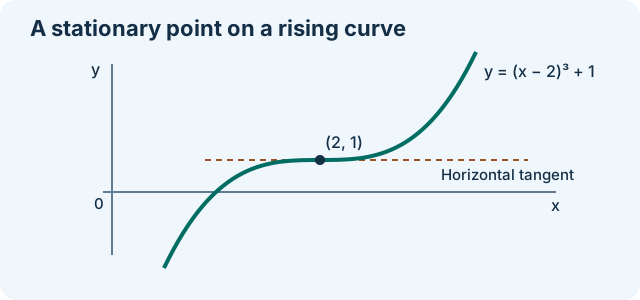
Let f(x) = (x − 2)³ + 1. Its derivative is 3(x − 2)², which is zero at x = 2 and positive on either side. The graph rises from f(1) = 0 to f(2) = 1 to f(3) = 2, with a horizontal tangent at (2, 1).
Its second derivative is 6(x − 2), which changes from negative to positive at 2. The graph changes concavity there, so (2, 1) is a stationary point of inflection.
Use a sign test to classify two points
For g(x) = x³ − 12x, the derivative is 3(x − 2)(x + 2). The zeros are −2 and 2. Use a test value in each interval formed by these zeros. The derivative is positive at −3, negative at 0, and positive at 3. It has a constant sign on each of those intervals because the factors have no other zeros.
At x = −2, the sign goes from positive to negative, so g has a local maximum at (−2, 16). At x = 2, the sign goes from negative to positive, so g has a local minimum at (2, −16).
See why a zero second derivative leaves the question open
For h(x) = (x − 2)⁴ + 1, h′(2) and h″(2) are both zero, just as in the cubic example. But h′(x) = 4(x − 2)³ is negative to the left and positive to the right, giving a local minimum at (2, 1).
The quartic’s second derivative is 12(x − 2)². It is positive on both sides, so there is no change of concavity at that point. When the second derivative is zero at a stationary point, check the surrounding signs to classify it.
Keep slope and concavity separate
The first derivative tells you whether the function rises or falls. The second derivative can tell you whether that slope is increasing or decreasing. A point of inflection requires a change of concavity. A turning point is a local maximum or minimum in these examples.
Some courses call slope gradient. The derivative is the slope of a tangent, and the sign test looks at how that slope behaves on each side of the candidate point.
Check nearby values when the derivative is undefined
A turning point can also occur at a corner. For y = |x − 2| + 1, the function falls with slope −1 and rises with slope 1. The corner at (2, 1) is a local minimum even though the derivative there is undefined.
When looking for interior extrema of a continuous function, include points where the derivative is zero and points in the domain where it is undefined. Then classify them from the nearby behavior.
Try two quick classifications
Find the first derivative and compare its signs just before and after x = 1.
- For y = −(x − 1)⁴, the derivative changes from positive to negative, giving a local maximum at (1, 0).
- For y = −(x − 1)³, the derivative is negative on both sides, so the graph keeps decreasing. The second derivative changes sign, giving a stationary inflection point at (1, 0).
Practise making a sign chart
For the next curve, list the candidate points in order, mark the sign of the first derivative on each side, and give your classification in words. If factoring or reading signed slopes is the sticking point, review those skills first.