

Why does swapping the two points in the slope formula give the same slope?
The short answer
Swapping the points reverses both changes. If the change in y was −4 and the change in x was +6, travelling back makes those changes +4 and −6. Both ratios equal −2/3. You can start at either point as long as you use the same start and finish for both coordinates.
For two points with different x-coordinates, the slope is m = (y₂ − y₁)/(x₂ − x₁). Each subtraction means finish minus start. Keep the coordinates of each point paired, so y₂ and x₂ always describe the same finish.
Read rise and run as signed changes
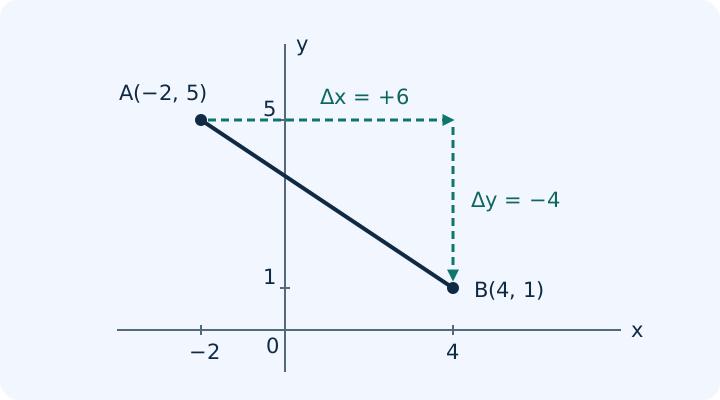
In the diagram, start at A(−2, 5) and finish at B(4, 1). To get from A to B, move 6 units right and 4 units down. The horizontal change is +6 and the vertical change is −4, so the slope is −4/6 = −2/3.
The word rise in rise over run includes downward movement. A rise of −4 means y falls by 4. The slope describes a decrease of 2 in y for every increase of 3 in x along this straight line.
Reverse the trip and compare the two fractions
Start at B(4, 1) instead. To reach A(−2, 5), the change in x is −2 − 4 = −6. The change in y is 5 − 1 = +4. The slope is now written as 4/(−6), which still equals −2/3.
In symbols, if the original changes are Δy and Δx, the reversed changes are −Δy and −Δx. Multiplying the top and bottom of a fraction by −1 preserves its value when the denominator is nonzero. This is the same fraction reasoning used to simplify a quotient.
Catch the sign error before simplifying
For A and B, writing (1 − 5)/(−2 − 4) gives +2/3. The top follows A to B, while the bottom follows B to A. Check which point supplies the first number in each subtraction. Both first numbers should come from the same point.
If a graph is available, read it left to right. An upward line has positive slope. A downward line has negative slope. Here B is to the right of A and lower, so a positive answer signals a setup error.
Use the axis values when reading a graph
Count coordinate units using the labels on each axis. For example, if each horizontal square represents 2 minutes and each vertical square represents 5 metres, moving three squares right and two squares up means a run of 6 minutes and a rise of 10 metres. The slope is 10/6 = 5/3 metres per minute.
Counting only the squares would produce 2/3. Checking the units helps you catch the difference, especially when the axes use different scales or measure different quantities.
Recognize horizontal, vertical, and repeated points
Check the x-coordinates before dividing. Distinct points with equal x-coordinates determine a vertical line.
- From (−3, 4) to (2, 4), the change in y is zero and the run is 5. The horizontal line has slope 0/5 = 0.
- From (2, −3) to (2, 4), the change in x is zero. The vertical line has undefined slope because 7/0 is undefined.
- Two copies of (2, 4) give both changes as zero. One point alone leaves the direction of the line undetermined.
Try both directions yourself
Find each slope. Then repeat the calculation with the start and finish swapped. In each case, check the sign by considering what happens to y as x increases.
- (−3, −2) and (5, 4). The changes are +6 and +8, so m = 3/4. Reversing gives −6/(−8) = 3/4.
- (1, 8) and (5, 2). The changes are −6 and +4, so m = −3/2. Reversing gives 6/(−4) = −3/2.
- (−4, 3) and (2, 3). The changes are 0 and +6, so m = 0. Reversing gives 0/(−6) = 0.
Apply the same routine to a new problem
Some courses call this quantity the gradient. In either vocabulary, mark your start and finish, subtract the two y-values and the two x-values in that order, and check the denominator before dividing. For a rate problem, keep the units of y over the units of x.
If signed subtraction or fraction simplification slowed you down, use the readiness diagnostic to pinpoint the skill to practise next.