

How do you know whether to use Pythagoras or trigonometry to find a missing side or angle?
The short answer
First confirm that you are working with a right triangle. If you know two side lengths and want the third, Pythagoras is usually the simplest route: a² + b² = c², where c is the hypotenuse. If you know one side and an acute angle and want another side, use a trigonometric ratio: sine, cosine, or tangent.
If you know two sides and want an acute angle, use inverse sine, cosine, or tangent. Choose the ratio that connects your known sides to the unknown. The given 90° angle establishes that the triangle is right-angled; it does not replace the acute angle needed for a side-finding trigonometric calculation.
Check the right angle before choosing either shortcut
Look for a 90° label, a small square marking, or information that establishes perpendicular sides. A triangle looking right-angled in a sketch is not sufficient evidence. In a word problem, a horizontal surface meeting a vertical wall may supply the right angle if that is part of the stated model.
The Pythagorean theorem and the basic opposite/adjacent/hypotenuse ratios used here apply to right triangles. For a triangle without a known right angle, you may need a different method, such as the sine rule, cosine rule, or a justified construction that creates a right triangle. Do not apply a² + b² = c² to any three-sided shape just because you recognize the formula.
In a larger diagram, isolate the particular triangle you are solving. One part of a problem may need Pythagoras, while a later part needs trigonometry. The information in that specific triangle determines the next step.
Label the sides relative to the angle you are using
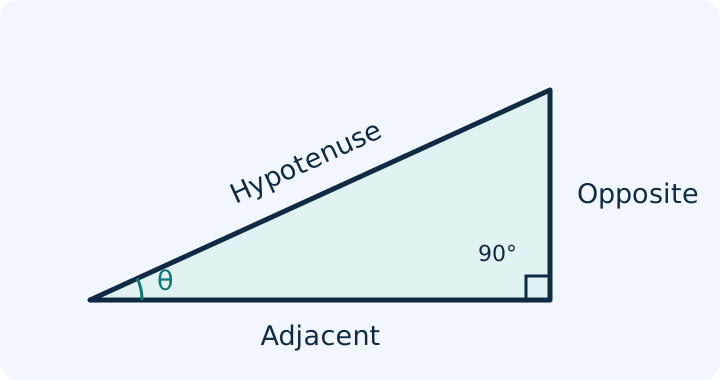
The hypotenuse is opposite the 90° angle and is the longest side. Relative to the chosen acute angle θ, the opposite side is across from θ. The adjacent side is the leg touching θ; exclude the hypotenuse when choosing the adjacent side for these ratios.
If you choose the other acute angle, opposite and adjacent swap roles. The hypotenuse stays the same. That is why labelling sides before choosing a ratio is more reliable than labelling them left, bottom, or sloping. Rotating the picture does not change the mathematics.
Worked example: two known sides point to Pythagoras
A right triangle has legs of 9 cm and 12 cm. Find its hypotenuse c. Write 9² + 12² = c², so 81 + 144 = 225 = c². The side length is c = √225 = 15 cm. Only the positive length is relevant.
Now suppose the hypotenuse is 20 cm and one leg is 12 cm. For the missing leg b, write 12² + b² = 20². Subtract 144 to obtain b² = 256, then b = 16 cm. When finding a leg, subtract its partner's square from the hypotenuse's square; adding the squares would give a length larger than the hypotenuse.
These examples need no acute angle measurement because Pythagoras directly relates all three sides of a right triangle. Check that the hypotenuse is the longest side and that the squared lengths satisfy the original equation.
Worked example: one side and an angle point to a ratio
A right triangle has a hypotenuse of 12 cm and an acute angle of 35°. Find the leg opposite that angle. Sine connects opposite and hypotenuse, so sin(35°) = opposite/12. Multiply by 12 to get opposite = 12 sin(35°), approximately 6.88 cm.
To find the adjacent leg instead, use cosine: cos(35°) = adjacent/12, giving adjacent = 12 cos(35°), approximately 9.83 cm. Both results are shorter than the 12 cm hypotenuse. Keep the unrounded values if you use them in a later step.
SOHCAHTOA is a memory aid for the three right-triangle ratios: sine = opposite/hypotenuse; cosine = adjacent/hypotenuse; tangent = opposite/adjacent. Right triangles sharing the same acute angle are similar, so these side ratios stay fixed even when the triangles are different sizes.
Worked example: finding an angle requires inverse trig
Relative to an unknown acute angle θ, a right triangle has opposite side 7 cm and adjacent side 10 cm. Tangent connects those two sides: tan θ = 7/10. Apply inverse tangent to obtain θ = tan⁻¹(0.7), approximately 35.0°.
Pythagoras could find the third side, but it would not directly tell you the angle. Since the two sides needed for tangent are already known, there is no need to calculate the hypotenuse first.
Here tan⁻¹ means inverse tangent, also called arctangent. It does not mean 1/tan. Use the inverse trigonometric function when the unknown is the angle, and use degree mode for these degree-based examples. Follow the rounding instruction in your own question.
Use the known and wanted quantities to choose the method
After marking the right angle, circle the known information and name what you need. This short decision routine keeps the formula connected to the task.
- Two known sides, third side wanted: usually use Pythagoras. Put the hypotenuse alone on the squared side of the equation.
- One known side and one known acute angle, another side wanted: choose sine, cosine, or tangent using the two side labels involved.
- Two known sides, acute angle wanted: use the inverse trig function matching those sides.
- Only angles known: the triangle's shape may be fixed, but its size is not. You need a length or equivalent information to find actual side lengths.
- Only one side and the 90° angle known: there is not enough information to determine every missing side or acute angle.
Rearrange the equation before entering numbers
A common error occurs when the unknown is the hypotenuse. If the adjacent leg is 9 cm and the acute angle is 40°, write cos(40°) = 9/h. Multiplying by h gives h cos(40°) = 9, then h = 9/cos(40°), approximately 11.75 cm. Multiplying 9 by cos(40°) would instead produce a shorter length and fail the hypotenuse check.
Always include the unknown in an equation before using a calculator. Then check the size and units of your result. Small rounding differences are expected when you check with rounded lengths; use full calculator values for intermediate steps when possible.
Some resources say Pythagoras' theorem, others Pythagorean theorem; right-angled triangle and right triangle also describe the same shape. This guide gives general mathematics, without claiming formal GCSE, IGCSE, IB, or US curriculum alignment or any assessment's required method.
Practice: choose a method before calculating
Assume every triangle below is right-angled. Name the method first, then check whether the answer is a length or an angle. Decimal answers are rounded as stated.
- 1. Legs 5 cm and 12 cm; find the hypotenuse. Pythagoras: c = √(25 + 144) = 13 cm.
- 2. Hypotenuse 18 cm and acute angle 30°; find the opposite leg. Sine: opposite = 18 sin(30°) = 9 cm.
- 3. Opposite leg 9 cm and adjacent leg 12 cm; find the acute angle. Inverse tangent: θ = tan⁻¹(9/12), approximately 36.9°.
- 4. Hypotenuse 26 cm and one leg 10 cm; find the other leg. Pythagoras: b = √(26² − 10²) = √576 = 24 cm.
Build the habit of matching information to a method
Before solving, confirm the right angle, label the relevant sides, and identify the unknown. Pythagoras connects side lengths; the basic trig ratios connect an acute angle with side ratios. Choosing a method becomes easier when you write down those relationships instead of searching for a familiar-looking formula.
If fractions, rearranging equations, or geometry foundations slow you down, start with the free VALYXIS secondary mathematics readiness diagnostic. Use the results to identify a starting point, then explore VALYXIS for focused practice and explanations.