

Why do you multiply by the reciprocal when dividing by a fraction?
The short answer
Dividing asks for the number that, when multiplied by the divisor, gives the starting amount. Multiplying by the divisor’s reciprocal undoes that multiplication because the divisor times its reciprocal equals 1.
In 3/4 ÷ 1/2, the question is how many half-cups fit into three-quarters of a cup. The answer is 1½ half-cups. The calculation 3/4 × 2 gives the same result.
Count equal-size pieces
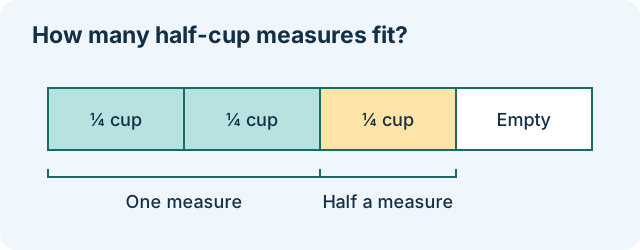
Mark a whole cup in quarters. Three-quarters of a cup fills three marks’ worth. A half-cup contains two quarters, so the number of half-cups is 3 ÷ 2 = 1½.
The leftover quarter-cup is half of the half-cup measure. The quotient counts half-cup measures, so 1½ describes the number of measures, while the water still amounts to 3/4 cup.
Use a common denominator for a second example
To find 5/6 ÷ 2/3, express both amounts in sixths. The divisor becomes 4/6. Now the problem asks how many groups of four sixths fit in five sixths, so the answer is 5 ÷ 4 = 5/4.
The shortcut gives 5/6 × 3/2 = 15/12 = 5/4. Multiplying the result by 2/3 gives 5/6, which checks the quotient.
See what the reciprocal does to an equation
Call the quotient q. Then 5/6 ÷ 2/3 = q means (2/3) × q = 5/6. Multiply both sides by 3/2. The product (3/2) × (2/3) is 1, leaving q = (3/2) × (5/6).
That move works for any nonzero divisor. The reciprocal belongs to the divisor because that is the factor multiplying q. In the shortcut often called keep-change-flip, keep the first number, change division to multiplication, and replace the second number with its reciprocal.
Use the rule with mixed numbers and signs
For 1½ ÷ 3/8, rewrite 1½ as 3/2. Then multiply 3/2 × 8/3 = 4. Four groups of 3/8 make 12/8, which equals 1½.
For −2/5 ÷ 3/4, multiply −2/5 by 4/3 to get −8/15. The reciprocal of a negative divisor also keeps its negative sign. Zero has no reciprocal, so division by zero is undefined.
Predict whether the result will be larger
For a positive starting amount, dividing by a positive number smaller than 1 gives a larger number because more of those smaller units fit. Dividing by a number larger than 1 gives a smaller number.
For example, 3/4 ÷ 3/2 = 1/2. The divisor is larger than the starting amount, so only half of one divisor-sized group fits.
Try three quick checks
Predict the size first, then check by multiplying your quotient by the divisor.
- 2/3 ÷ 1/6 = 4. There are four sixths in two-thirds.
- 3/5 ÷ 9/10 = 2/3. Multiplying 2/3 by 9/10 returns 3/5.
- 0 ÷ 2/7 = 0. This works because the divisor is nonzero.
Practise explaining the operation
For your next problem, say what the quotient counts or write the multiplication equation it must satisfy. If that step is difficult, practise equivalent fractions and multiplication before returning to the shortcut.