

Why do you square the length scale factor to find the area scale factor?
The short answer
Area scales by the square of the length scale factor because two dimensions change together. When every length is multiplied by k, both the width and height of an area unit scale by k. That unit covers k × k = k² times its original area.
To go from an area ratio back to a length factor, take the positive square root. In both directions, use the same order when comparing the original and new shapes.
Count square tiles to see both dimensions change
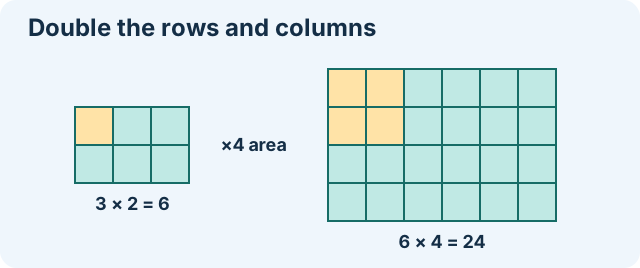
Start with a rectangle that measures 3 cm by 2 cm. It covers six 1 cm² squares. Double both dimensions to get a 6 cm by 4 cm rectangle. There are twice as many columns and twice as many rows, so the new rectangle covers 24 squares.
Each square from the original has become a 2 cm by 2 cm block with area 4 cm². Six such blocks cover 24 cm². The length factor is 2, and the area factor is 4.
Use the same reasoning for a triangle
A triangle has base 10 cm and perpendicular height 6 cm. Its area is ½ × 10 × 6 = 30 cm². Enlarge it by a length factor of 1.5. The new base is 15 cm and the new height is 9 cm, so the area is 67.5 cm².
The area factor is 1.5² = 2.25, and 30 × 2.25 = 67.5. The one-half in the triangle formula stays the same. Any polygon can be split into triangles, and the same factor applies to the area of each triangle.
Find a missing side from an area ratio
Two similar signs have areas of 48 cm² and 108 cm². The area factor from smaller to larger is 108 ÷ 48 = 9/4. The length factor is √(9/4) = 3/2, because (3/2)² = 9/4.
If a side on the smaller sign is 8 cm, the corresponding side on the larger one is 8 × 3/2 = 12 cm. You can also write the smaller-to-larger area ratio as 4:9 and the corresponding side ratio as 2:3.
A reduction squares a fraction
A 120 cm² design is reduced to half its original width and half its original height. The reduced design has area 120 × (1/2)² = 30 cm². Half as many centimetres in each direction leaves a quarter of the area.
If only the width is halved and the height is unchanged, the area is instead 60 cm². In that case the two directions use different factors, so the shapes are not similar.
Decide which quantity you are comparing
For similar solids, every corresponding length scales by k, surface area scales by k², and volume scales by k³. If the surface area factor is 4 and you need the volume factor, take √4 = 2 to recover the length factor, then cube 2 to get 8.
Label the quantity first. A length is measured in units such as cm, an area in square units such as cm², and a volume in cubic units such as cm³. Use corresponding measurements in the same units when forming a ratio.
Check your reasoning with three examples
For each one, name the known quantity and the quantity you need before calculating.
- An enlargement triples every side. An original area of 14 cm² becomes 14 × 3² = 126 cm².
- A similar design has 16/25 of the original area. Each new side is 4/5 of its original length.
- A rectangle doubles in width and triples in height. Its area becomes 2 × 3 = 6 times as large, and the unequal stretch factors change the shape.
Practise with ratios and measures
When a scale problem feels ambiguous, write a short sentence such as ‘the new area is nine times the old area.’ Then decide whether the next step needs an area, a length, or a volume.