
How can you tell whether two events are independent or mutually exclusive?
The short answer
Mutually exclusive events cannot happen together on the same trial. Independent events satisfy P(A and B) = P(A) × P(B). When P(A) is positive, independence means learning that A happened leaves the probability of B unchanged.
If both events have positive probability and are mutually exclusive, their actual overlap is zero while the product of their probabilities is positive. They are therefore dependent. To test independence, compare the actual overlap with the product of the separate probabilities.
Define both events on the same trial
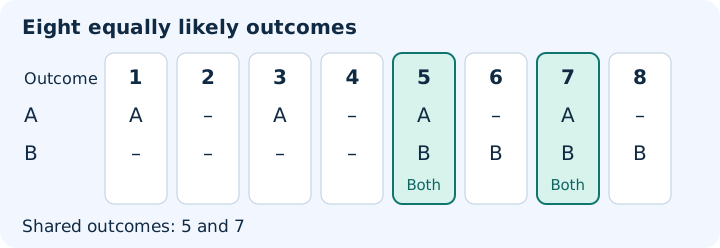
Imagine spinning once on a fair spinner numbered 1 through 8. Each number is equally likely. Event A is landing on an odd number, so A contains 1, 3, 5, and 7. Event B is landing above 4, so B contains 5, 6, 7, and 8.
The outcomes 5 and 7 meet both descriptions. The overlap tells you immediately that A and B can happen together. To decide whether they are independent, count how likely that overlap is.
Check independence by counting the overlap
Each event contains four of the eight outcomes, so P(A) = 1/2 and P(B) = 1/2. The overlap contains two outcomes, so P(A and B) = 2/8 = 1/4. That equals (1/2) × (1/2), which establishes independence.
You can also look only at the outcomes in A. Of the four odd numbers, two are above 4. The chance of B given A is 2/4 = 1/2, the same as the chance of B before you were told the result was odd. Both events describe a single spin, which shows that independent events can come from the same trial.
Compare the odd and even events
Keep A as the odd outcomes and let C be landing on an even number. C contains 2, 4, 6, and 8. The two sets share no outcomes, so A and C are mutually exclusive.
Now compare their overlap, 0, with P(A) × P(C) = 1/4. The values differ. Once you learn that the spin landed on an odd number, the chance that it landed on an even number falls from 1/2 to 0.
Overlap alone leaves independence open
On the same spinner, let D contain 5, 6, and 7. A and D overlap at 5 and 7, so the joint probability is 2/8 = 1/4. The product of the separate probabilities is (1/2) × (3/8) = 3/16. The joint probability and the product differ, so the events are dependent even though they can happen together.
The product test also covers the special case of an impossible event. If E is landing on 9, E shares no outcomes with A and has probability 0. Both P(E and A) and P(E) × P(A) equal 0. In this example, E and A meet both definitions.
Choose the formula from what the question asks
For A or B, include every outcome in either event. Add the separate probabilities and subtract the overlap once because both counts included it. For the odd and above-4 events, P(A or B) = 1/2 + 1/2 − 1/4 = 3/4. For mutually exclusive events, the overlap term is zero.
For A and B, count the outcomes shared by both events when the outcomes are equally likely. If you already know the events are independent, you can calculate the joint probability by multiplying their separate probabilities. If A has positive probability and you know P(B given A), the general multiplication rule is P(A and B) = P(A) × P(B given A).
Practise with three quick checks
Use the same fair eight-outcome spinner. Identify the shared outcomes, then compare their probability with the product of the two event probabilities.
- {1, 2} and {3, 4}. The overlap is empty and the product is 1/16. The events are mutually exclusive and dependent.
- {1, 2, 3, 4} and {2, 4, 6, 8}. Their two shared outcomes give 2/8, which equals (4/8) × (4/8). They are independent and can happen together.
- {1, 3, 5, 7} and {5, 6, 7}. Their overlap gives 2/8 and the product is 3/16. They can happen together and are dependent.
Start the next problem with the overlap
Some courses call mutually exclusive events disjoint. For either term, write out the trial and the events, identify the shared outcomes, and compare the overlap probability with the product when you need to test independence.
If the fraction steps are slowing you down, the readiness diagnostic can help you choose what to practise first.